
Showing posts with label definition of film. Show all posts
Showing posts with label definition of film. Show all posts
Saturday, April 22, 2023

Monday, March 14, 2022
Response to Inglorious Basterds - And what's with the incorrect spelling?
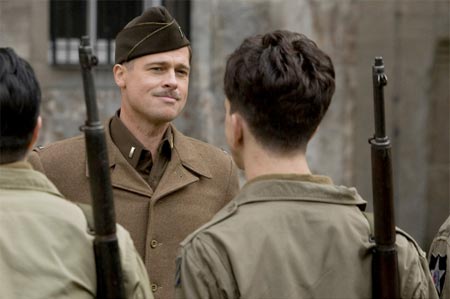
But that's OK, because we're not seeing an attempt to create a cinematic version or interpretation of historical events because all such movies are fabrications. All movies are fabrications, of course, and Tarantino is trying to remind the viewers of the fact. We are seeing an exercise in how a filmmaker controls what goes into the art. If Tarantino wants to create a bad scene, then he does so. It's as if he were saying, "I'm so in command of the grammar of cinema that I I'll make this scene too long, contrived, cliched, dull, etc., just to show I know the good and bad aspects of cinema.
He even has one actor, Mike Myers, play a cliched version of his own cliched actor's persona. He's not portraying a British officer. He's portraying Mike Myers. The range of jokes in the film go from the sublime to the ridiculous, the latter evident when Brad Pitt tries to fake an Italian accent at a gathering of SS officers. That is straight out of The Three Stooges or Mel Brooks. Additionally, the alteration of the Nazi sniper spy movie and the subsequent flames leaping around the movie screen have all the production values of an Ed Wood movie. You don't see "Plan 9 from Outer Space" because it's a good movie. You see it because it's a bad movie, although you might say it's so bad that it's good.
I'm not suggesting that I'm a Tarantino fan. I really don't care what movies he makes or why. I haven't seen "Kill Bill" which I believe he directed. This stuff isn't rocket science, so I wouldn't use such words as 'genuis' or 'brilliant.' But at least it's a change of pace from the usual Hollywood garbage.
You could take every scene and shot, and about every line of dialogue from this film and find a meta-communicative aspect. That's why it would be way too tedious to truly critique the film. It would take a thousand pages or so. But you get the idea. Now go find a few 'bad jokes' of your own if you have the inclination. BTW, what better way to show the artifice of film titles, and in particular, the way titles of films are used to stand out as a form of a film's PR than to misspell one?
Thursday, March 8, 2012
Michael Clayton: Analogies to the book of Jonah?
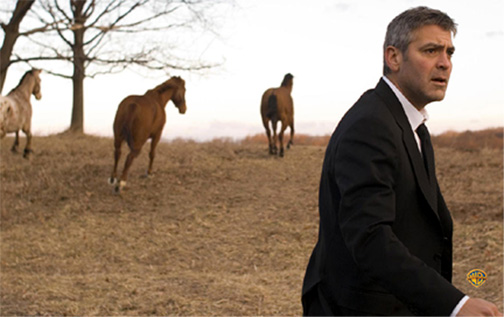
Many have remarked the opening of Michael Clayton is an example of exemplary film dialogue, particuarly the extended speech of Clayton's colleague, who has discovered that his life is a lie (so to speak). Is this the raving of a bipolar sufferer or the message of a prophet? First consider the speech:"Two weeks ago, I came out of the building, okay. I'm running across Sixth Avenue, there's a car waiting, I got exactly 38 minutes to get to the airport and I'm dictating. There's this, this panicked associate sprinting along beside me, scribbling in a notepad, and suddenly she starts screaming, and I realize we're standing in the middle of the street, the light's changed, there's this wall of traffic, serious traffic speeding towards us, and I- I-I freeze, I can't move. And I'm suddenly consumed with the overwhelming sensation that I'm covered with some sort of film. It's in my hair, my face. It's like a glaze like a- a coating, and, at first I thought, oh my God. I know what this is, this is some sort of amniotic - embryonic - fluid. I'm drenched in afterbirth, I've-I've breached the chrysalis, I've been reborn. But then the traffic, the stampede, the cars, the trucks, the horns, the screaming and I'm thinkin' no-no-no-no, reset, this is not rebirth. This is some kind of giddy illusion of renewal that happens in the final moment before death. And then I realize no-no-no, this is completely wrong because I look back at the building and I had the most stunning moment of clarity.
I- I-I- I realized Michael, that I had emerged not through the doors of Kenner, Bach, and Ledeen, not through the portals of our vast and powerful law firm, but from the asshole of an organism whose sole function is to excrete the- the-the-the poison, the ammo, the defoliant necessary for other, larger, more powerful organisms to destroy the miracle of humanity. And that I had been coated in this patina of s--t for the best part of my life. The stench of it and the stain of it would in all likelihood take the rest of my life to undo. And you know what I did? I took a deep cleansing breath and I set that notion aside. I tabled it. I said to myself as clear as this may be, as potent a feeling as this is, as true a thing as I believe that I have witnessed today, it must wait. It must stand the test of time. And Michael, the time is now."
Consider the resemblances to flee. He goes to Tarshish. God calls up a great storm at sea, and the ship's crew cast Jonah overboard in an attempt to appease God. A great sea creature sent by God, swallows Jonah. Inside the fish's belly, he says a prayer in which he repents for his disobedience and thanks God for His mercy. God speaks to the fish, which vomits out Jonah safely on dry land. After his rescue, Jonah obeys the call to prophesy against Nineveh, and they repent and God forgives them. Jonah is furious, however, and angrily tells God that this is the reason he tried to flee from Him, as he knew Him to be a just and merciful God. He then beseeches God to kill him, a request which is denied when God causes a tree to grow over him, giving him shade.
In Michael Clayton, Michael may be God's messenger who involves himself in rectifying the evil that his colleague has uncovered.
Consider the resemblances to flee. He goes to Tarshish. God calls up a great storm at sea, and the ship's crew cast Jonah overboard in an attempt to appease God. A great sea creature sent by God, swallows Jonah. Inside the fish's belly, he says a prayer in which he repents for his disobedience and thanks God for His mercy. God speaks to the fish, which vomits out Jonah safely on dry land. After his rescue, Jonah obeys the call to prophesy against Nineveh, and they repent and God forgives them. Jonah is furious, however, and angrily tells God that this is the reason he tried to flee from Him, as he knew Him to be a just and merciful God. He then beseeches God to kill him, a request which is denied when God causes a tree to grow over him, giving him shade.
In Michael Clayton, Michael may be God's messenger who involves himself in rectifying the evil that his colleague has uncovered.
Monday, February 20, 2012

Friday, January 13, 2012
John Cassavetes talks about film and cinema

Most people don’t know what they want or feel. And for everyone, myself included, It’s very difficult to say what you mean when what you mean is painful. The most difficult thing in the world is to reveal yourself, to express what you have to… As an artist, I feel that we must try many things – but above all, we must dare to fail. You must have the courage to be bad – to be willing to risk everything to really express it all. –John Cassavetes
Monday, January 9, 2012
Christopher Doyle on Film
Christopher Doyle:
The clouds moving across the road in random patterns, the traffic, what's going on by the roadside - all affect the shot. So you have to think just a little ahead, beyond your mundane self. Why fall back on old habits and other people's ways? Why not trust your eyes and intuition? Why not use taste instead of training? Try to find what best expresses what's going on, what's exciting to your eye. What you end up with may not be "new", it may not be brilliant, but at least you can say it's you.
Jean Renoir on Film
All technical refinements discourage me. Perfect photography, larger
screens, hi-fi sound, all make it possible for mediocrities slavishly
to reproduce nature; and this reproduction bores me. What interests me
is the interpretation of life by an artist. The personality of the film
maker interests me more than the copy of an object.
Jean Renoir
Subscribe to:
Posts (Atom)